Reading Format Goal Map
- Print helps many readers with focus, spatial memory, annotation, and screen-free reading.
- Ebooks help with portability, search, accessibility settings, and instant access.
- Audiobooks help with time-shifting, accessibility, rereading, and narrative immersion while doing compatible tasks.
- The best reader often uses all three formats for different goals instead of treating one as the only real reading.
Audiobooks, ebooks, and print books each support different reading goals. Print is best for focused screen-free reading, ebooks are best for portable and searchable libraries, and audiobooks are best when listening lets you make time for books you would otherwise miss.
Reading goals should choose the format
The question “which format is best?” becomes clearer when you replace it with “what am I trying to do with this book?” Studying a dense argument, relaxing before bed, commuting, sampling a new author, revisiting a favorite novel, and supporting accessibility needs are different tasks. One format rarely serves all of them equally well.
Current Pew Research Center reading-format research shows print still has a strong place among readers, while the American Library Association’s ebook advocacy work highlights how digital access can be shaped by licensing. The Library of Congress National Library Service also shows why audio and accessible formats are not side options; they are central for many readers.
If your reading overlaps with comics or serialized visual storytelling, this manga and Western comics comparison explains why format can change how a story is experienced.
A practical format comparison
| Format | Best reading goals | Watch-outs |
|---|---|---|
| Deep focus, margin notes, gifts, collecting, screen breaks | Less portable, no instant search, physical storage | |
| Ebook | Travel, search, adjustable text, large libraries, quick purchase or borrowing | Device dependence, licensing restrictions, screen fatigue |
| Audiobook | Commuting, chores, accessibility, rereads, voice performance | Harder for visual reference, note-taking, dense diagrams, names or dates |
This comparison is not a hierarchy. A printed poetry collection, an ebook mystery for travel, and an audiobook memoir may each be the best version of reading for that purpose. Reading is not weakened because the format changes; the cognitive task changes.
Print supports attention and physical memory
Print books are useful when you want to slow down. Physical pages give a sense of progress, and many readers remember where an idea appeared in the object. Print also removes app notifications, battery anxiety, and platform interfaces. For literary study, complex nonfiction, art books, and books you want to keep visible, print can be the most satisfying format.
Print’s trade-offs are weight and storage. Large hardcovers are inconvenient on commutes, and a growing library needs space. Print can also be less flexible for readers who need larger type, adjustable contrast, audio support, or instant dictionary tools.
Ebooks make libraries portable
Ebooks shine when you move often or read across many titles. Adjustable font size, built-in search, bookmarks, highlights, dictionaries, and sync can make reading easier. They are especially useful for travel, night reading, public library borrowing, and sampling books before buying a physical copy.
The caution is control. Not every ebook is owned in the same sense as a printed book on your shelf. Platform rules, file formats, library licensing, and device ecosystems affect access. Readers who care about long-term ownership should understand where their files live and what rights they actually have.
Audiobooks turn unused time into story time
Audiobooks are ideal when your eyes or hands are busy but your attention is available: walking, cleaning, cooking, commuting, or resting. Narration can add performance, pacing, accent, humor, or intimacy. Memoirs read by their authors can feel especially direct, while fiction with strong voice work may become a distinct interpretation.
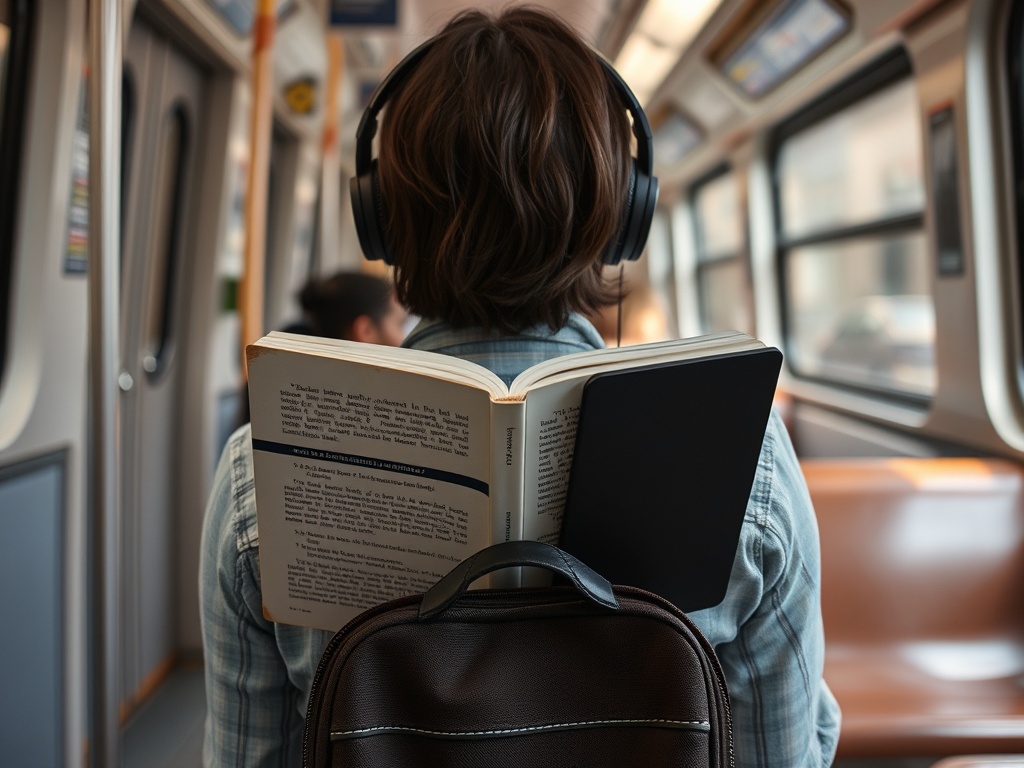
Audiobooks are less ideal for heavily visual books, footnote-heavy academic work, recipes, reference texts, or books where you need to flip back often. They also require honest attention. If you miss key sections while multitasking, the format is not failing; the task pairing is wrong. For another media choice shaped by context, see this comparison of vinyl, streaming, and CDs.
Cost and access look different by format
Print has used bookstores, library copies, gifts, and resale. Ebooks have sales, bundles, instant borrowing, and adjustable access, but licensing can complicate library availability. Audiobooks often cost more to produce and may rely on subscriptions, credits, or library holds. The cheapest format depends on your library, your patience, and your willingness to buy used or wait.
Accessibility is not a bonus feature. For some readers, audio, large type, screen readers, braille, or adjustable displays are what make reading possible. A format comparison should respect that different bodies and contexts require different routes into the same work.
Match Format to Book Type
The book itself should influence the choice. Narrative nonfiction, memoir, and dialogue-rich novels often work well in audio. Reference books, art books, cookbooks, poetry collections, and heavily footnoted scholarship usually benefit from print or ebook visibility. Ebooks can be excellent for long series because search and portability reduce friction. Print can be better for books you want to keep returning to physically. Format becomes easier to choose when you respect the demands of the specific work.
You can also split a single book across formats. Some readers listen to a chapter, then revisit difficult sections in print or ebook. Others read print at home and use audio for rereading. Mixing formats is not cheating; it can reinforce memory when the book is worth deeper attention.
That approach is especially useful for book clubs, school reading, or research projects where recall matters as much as finishing.
Build a Format Mix Around Your Life
Use print for books you want to study, display, annotate, or enjoy away from screens. Use ebooks for portability and search. Use audiobooks when listening creates reading time that would not exist otherwise. A flexible reader does not need to defend one format against the others.
Choose the format that removes your biggest barrier for the specific book in front of you. If you finish more books, understand them better, and return to ideas with less friction, the format is doing its job.